


We didn’t “crack” the account with a new targeting trick.
We cracked it with one winning hook.
Simple story. Clear promise. Stupidly high CTR.
Then we ran that hook through our AI stack.
Suddenly, it wasn’t “one ad” anymore. It was:
15+ creative variations
4 aspect ratios (1:1, 9:16, 4:5, 16:9)
Multiple tones, creators, and openings
All built on the same core idea
That’s when it clicked:
The Old Playbook Is Broken
Here’s how most teams still work:
Creative team makes an ad. It runs for two weeks. Performance dips. Everyone scrambles to make “the next ad.”
Rinse. Repeat. Burnout.
The problem? On saturated channels like Meta, ads are a volume game.
The algorithm doesn’t reward your one beautiful ad. It rewards whoever can feed it enough fresh creative to find cheap pockets of attention.
One great hook isn’t the finish line. It’s the starting point.
One hook = a whole creative tree. 🌳
Your job isn’t to find a miracle ad. Your job is to find a repeatable hook and teach AI to spin it into a small army of creatives.
Here my (agile) workflow
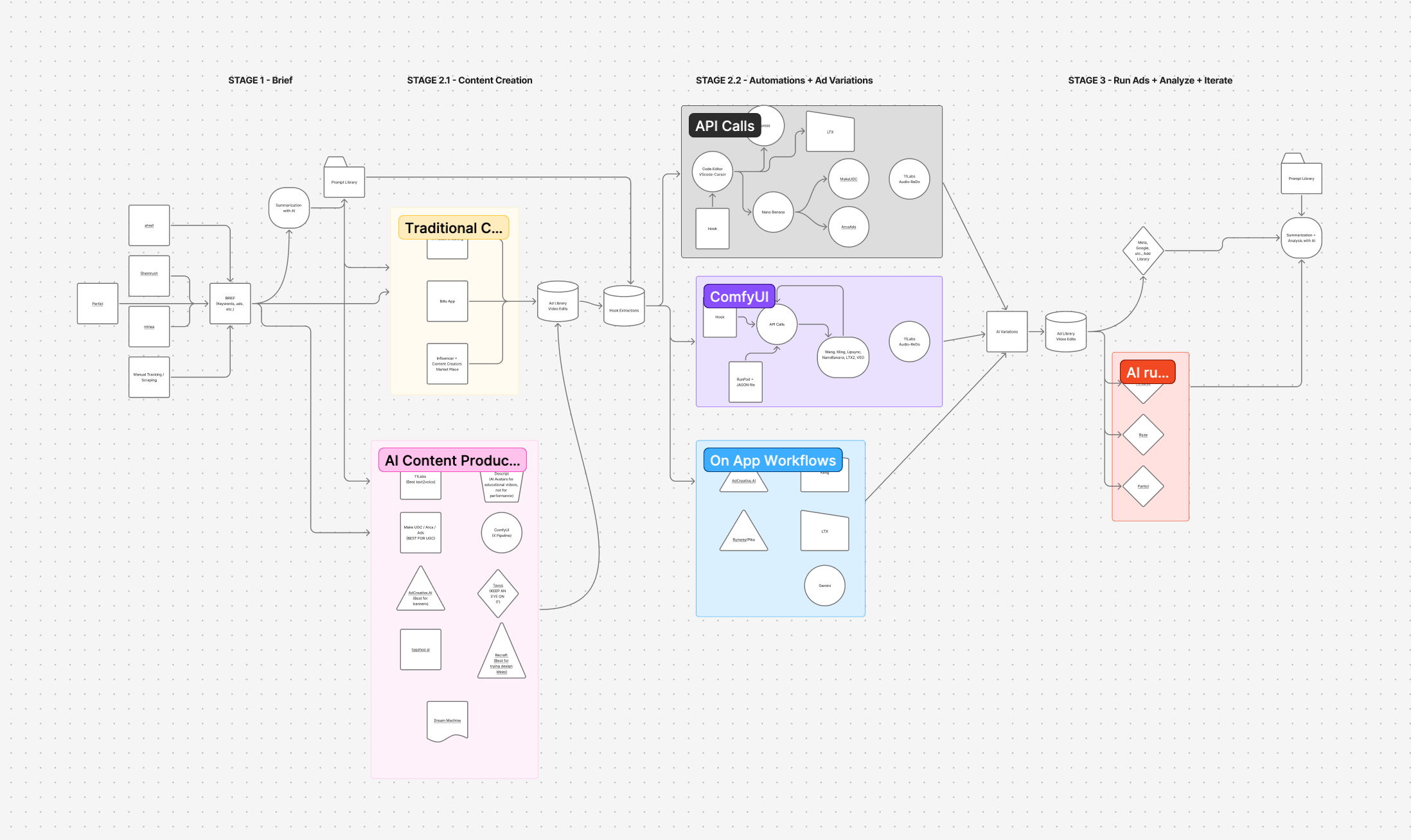
1 Start With the Hook That Deserves 15 Lives
In crowded feeds, you don’t have room for “clever.”
You need a hook that is brutally obvious:
Problem → “This is annoying, right?” Shift → “Here’s the new way.” Payoff → “Here’s what you get.”
Think things like:
“Turn any bad photo into a perfect profile pic.”
“Fix your lighting in one tap—no studio, no gear.”
“Erase anything from your photos in 3 seconds.”
Once one of these hooks proves it can pull attention and clicks, that’s the seed.
You don’t just duplicate the ad and tweak colors. You multiply the hook.
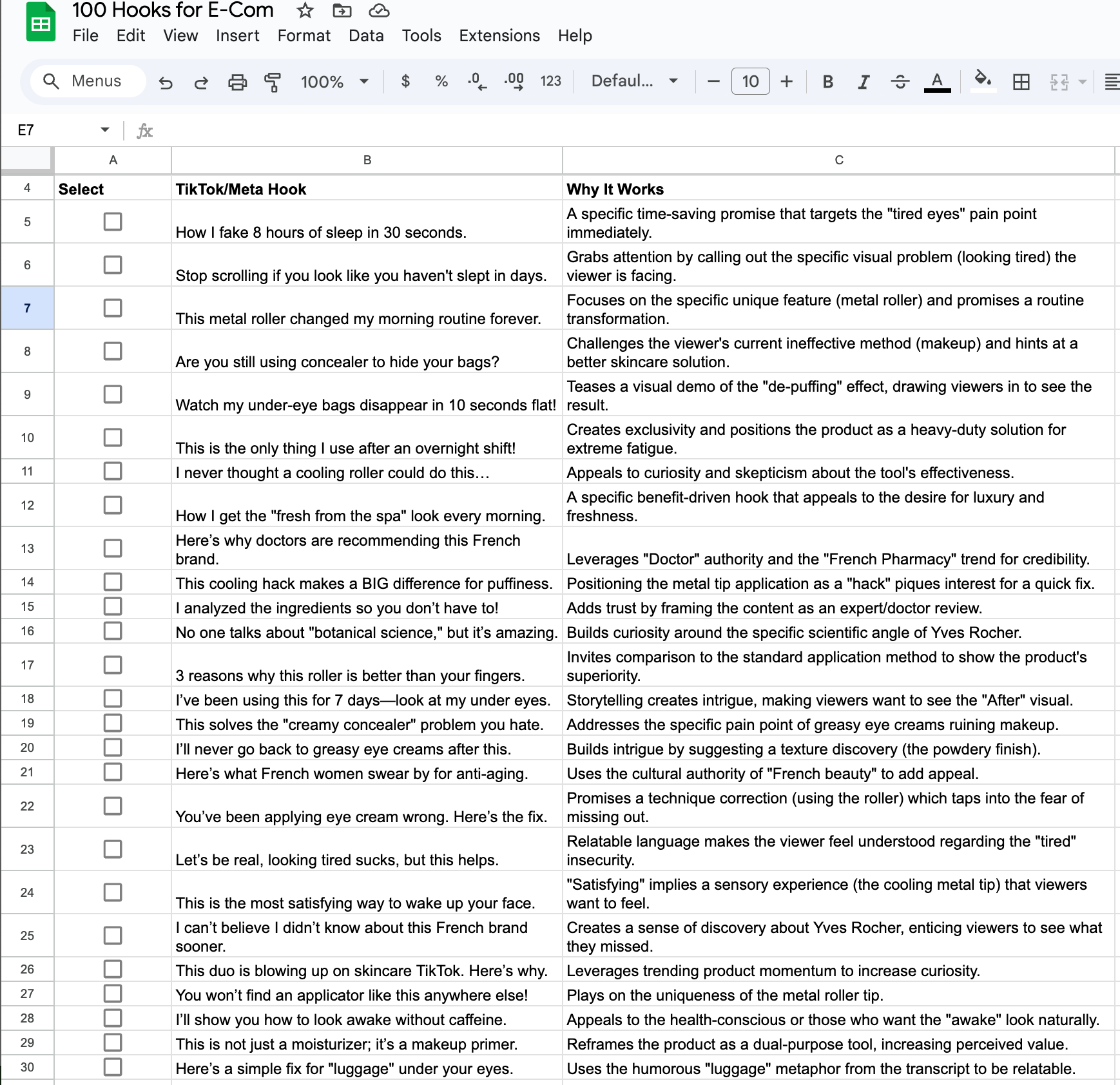
I’m going to show you how to take one video asset and multiply it into a library of 15+ high-converting variations using the modern AI stack. We aren’t just changing captions here; we are changing the video reality itself.
2 🧠 The Framework: Models vs. Tools vs. Platforms
Before we get to the tactic, you need to stop confusing the terminology. Most marketers use these words interchangeably. That’s a mistake.
To pull this off, you need to understand the AI Video Stack:
The Engine (Models): These are the brains. Think Kling or VEO. They are the raw intelligence generating the pixels.
The Workshop (Tools): This is where you tinker. ComfyUI is the heavyweight here. It gives you infinite control to chain models together, but it requires a “builder” mindset.
The Factory (Platforms): This is for scale. MakeUGC and ArcadS. These platforms wrap the technology into a user-friendly interface, specifically for things like talking avatars and consistent character generation.
The “Moonshot” Idea: Stop testing text variations. Start testing reality variations.
🧪 The “Hook Library” Strategy
Here is the exact workflow to turn one video into a scalable PPC asset for E-com.
Step 1: Isolate the “Source Code”
Take your winning video. Identify the first 3 seconds (the Hook).
Maybe it’s a UGC creator saying, “Stop using regular soap.”
Step 2: Choose Your Weapon (ComfyUI vs. Platforms)
Option A: The Control Freak (ComfyUI)
If you want granular control over lighting, texture, and scene composition, use ComfyUI with the Kling model.
The Play: Use “Video-to-Video” transformations. Keep the motion of your winning ad, but swap the environment.
Result: The same winning hook, but now the creator is on a beach, in a luxury apartment, or in a neon-lit studio.
Option B: The Scale Master (MakeUGC / ArcadS)
If you need talking heads that look human (but aren’t), this is where the money is.
The Play: Upload your script to MakeUGC or ArcadS. Their tech uses advanced lip-sync and facial modeling (often superior for direct-to-camera speech compared to raw models).
Result: You generate the same winning script delivered by 5 different “Avatars” (different ages, ethnicities, and genders) in minutes.
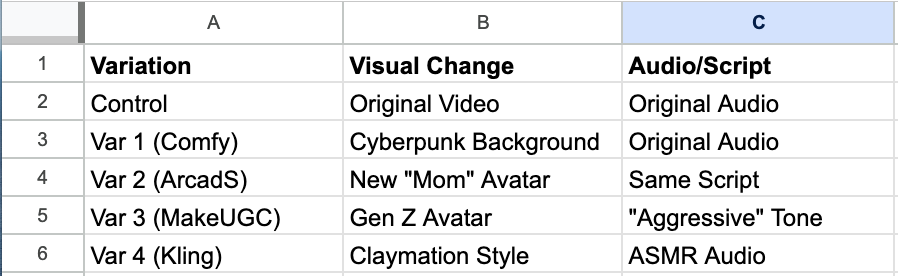
Step 3: Build the Matrix
Now, you don’t just have one ad. You have a Hook Library.
💡 Why It Works (Psychology)
This taps into the “Mere Exposure Effect” but bypasses the “Habituation” filter.
Familiarity: The core message (the script/hook) remains the same, building brand memory.
Novelty: The visual “wrapper” changes completely.
To the human brain (and the Meta algorithm), these look like completely new ads. But they are built on the skeleton of a proven winner.
The Result: You extend the life of a winning concept from 2 weeks to 6 months.
3 Build a Media Library That Remembers What Worked
When you’re pumping out variants, chaos is a feature… until it kills you.
So you need a simple structure that answers:
Which hooks are proven?
Which styles won for each hook?
What died from fatigue and shouldn’t be revived?
Even a basic spreadsheet with these columns works:
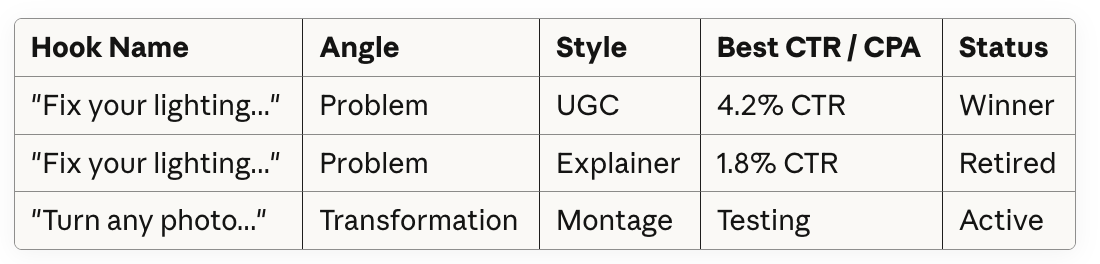
This turns your ad account into a library of proven patterns, not random uploads.
When a hook starts fatiguing, you don’t panic. You check your library, see which styles haven’t been tested yet, and spin up the next batch.
The New Question
On Meta and other saturated platforms, the algorithm rewards volume and resilience, not perfection.
So don’t ask, “What’s my next great ad?”
Ask instead:
“Which of your winning hooks is sitting there with only one life? And how fast can you give it 14 more?”